

Agnes Martin Paintings and Drawings 1974–1990 – Complete Portfolio of Ten Lithographs
About the Artwork
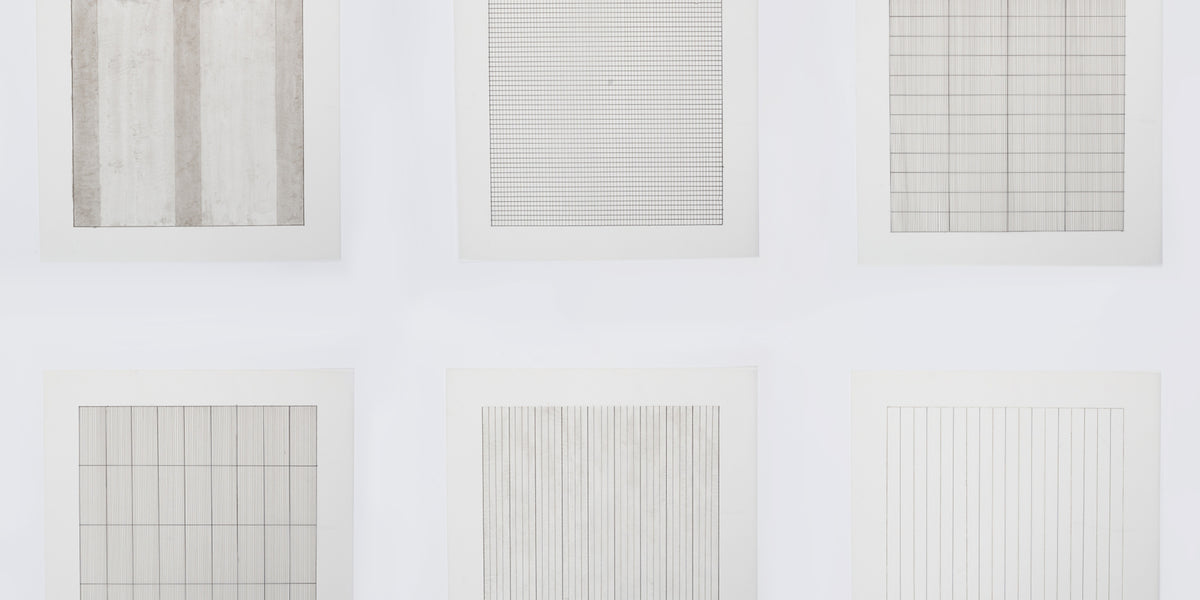
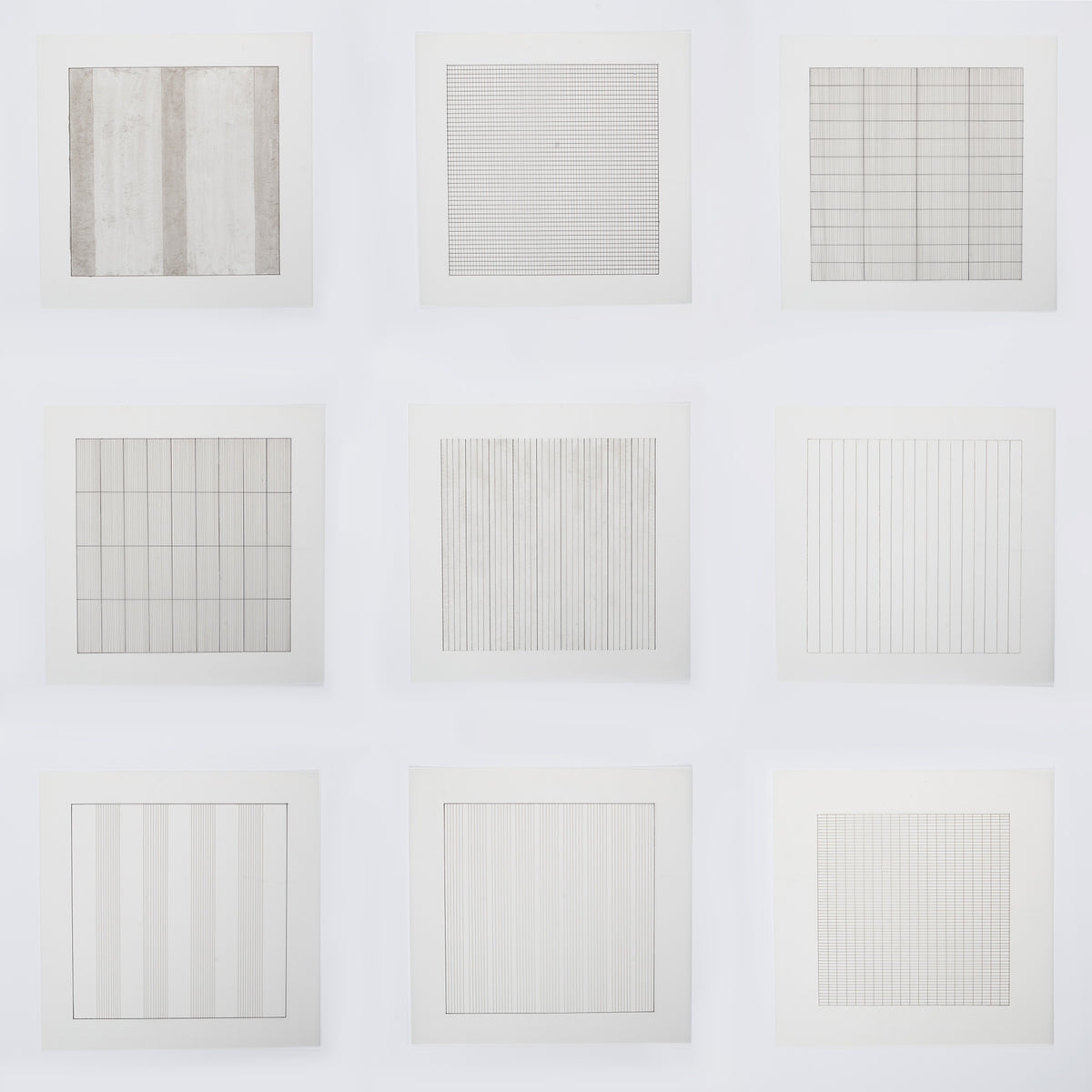
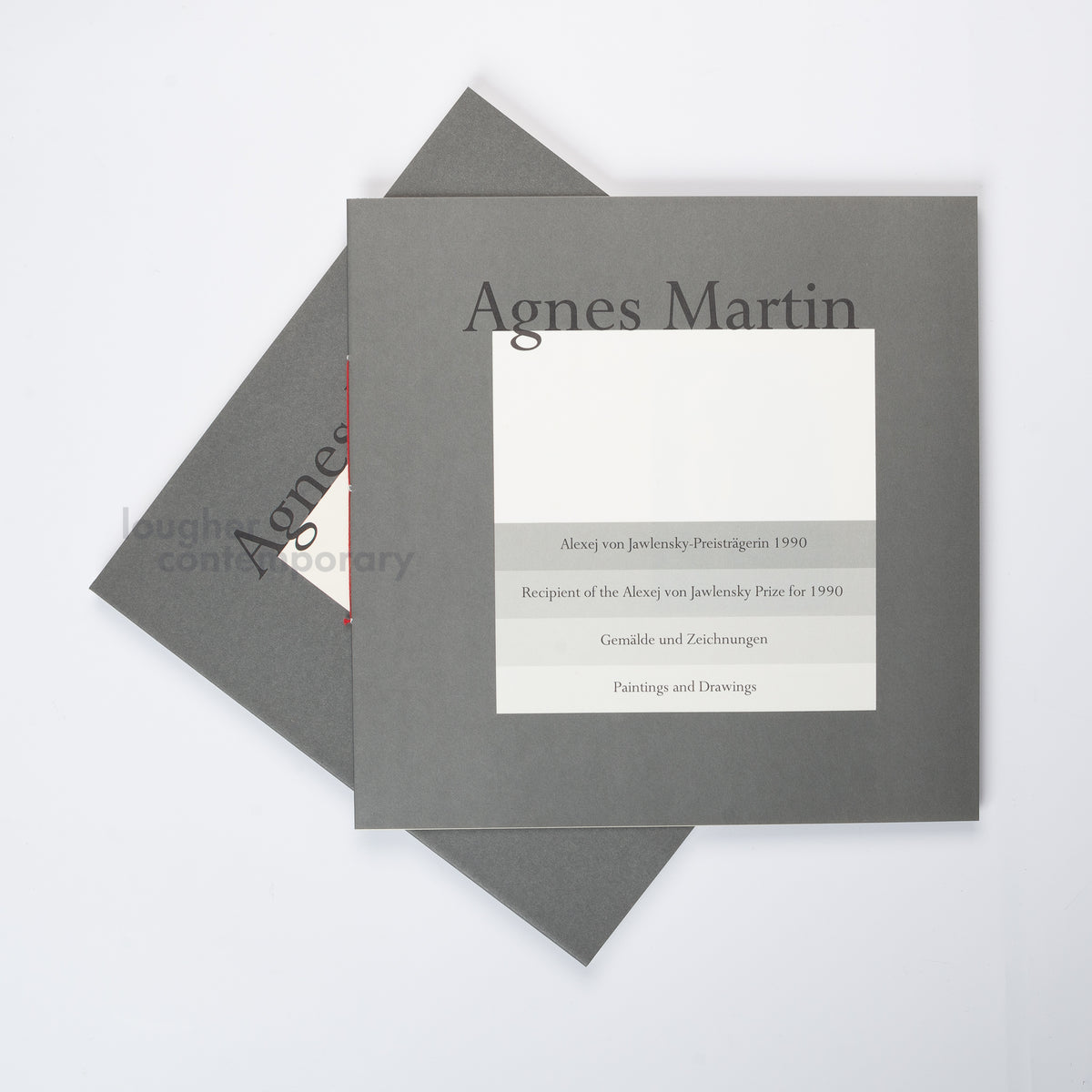
Agnes Martin’s Paintings and Drawings 1974–1990 is a complete portfolio of ten lithographs that brings together the quiet geometry, subtle colour and meditative restraint that define one of the most influential American artists of the 20th century.
Published in connection with Martin’s major retrospective at the Stedelijk Museum, Amsterdam, the portfolio translates compositions from an important period of her practice into a more intimate print format. Lougher Contemporary offers the complete set of ten lithographs, produced in an edition of 2,500 and presented in the original packaging. Each sheet measures approximately 30.5 × 30.5 cm. The works are unsigned and unnumbered.
The portfolio occupies an important position within Martin’s printmaking practice. Although she is best known for her paintings and drawings, Martin was a significant printmaker who repeatedly returned to screenprinting and lithography as a means of exploring the qualities of line, repetition and subtle colour. Hidden Gallery notes that printmaking allowed Martin to develop her characteristic graphic language while experimenting with the precision and delicacy that were central to her work.
The Paintings and Drawings 1974–1990 portfolio is particularly compelling because it makes Martin’s celebrated visual language available across a complete group of works. Rather than presenting a single isolated composition, the portfolio allows the collector to experience the relationships between different variations on her recurring vocabulary of grids, stripes, bands and delicate geometric structures.
The works are derived from a period in which Martin produced many of her best-known paintings. Between 1974 and 1993, she worked extensively with large square canvases, often measuring six feet square. The lithographs associated with Paintings and Drawings 1974–1990 translate this monumental practice into a smaller, highly considered format.
For collectors, the result is an unusually accessible way of engaging with Martin’s mature practice while retaining the conceptual and visual coherence of a significant artist’s portfolio.
The Paintings and Drawings Portfolio
Martin’s art can initially appear remarkably simple: a square, a grid, a series of horizontal lines or a restrained field of colour.
Yet the apparent simplicity is the result of extraordinary control.
Across Paintings and Drawings 1974–1990, Martin’s compositions explore repetition, proportion, spacing and subtle shifts in tone. The absence of conventional imagery directs attention towards the physical experience of looking. Lines become rhythm; intervals become important; colour is experienced as atmosphere rather than description.
The portfolio is made up of ten lithographs on vellum/transparency paper, each approximately 30.5 × 30.5 cm. Lougher records the complete portfolio as an edition of 2,500, unsigned and unnumbered.
The choice of transparent or translucent paper is particularly appropriate to Martin’s practice. Her work often depends upon delicacy and optical nuance rather than strong contrast. The surface allows the works to retain an extraordinary lightness, while the lithographic process provides the precision required for Martin’s carefully controlled lines.
Martin’s grid is among the most recognisable motifs in post-war American abstraction. Yet she resisted the idea that her work should be understood purely through formal systems. Hidden Gallery records Martin’s explanation that the grid emerged from her thoughts about the innocence of trees, and that she continued to associate the grid with innocence.
This is an important distinction when considering Martin as a collector. Her work is often associated with Minimalism because of its geometry, repetition and restraint, but Martin herself identified more closely with Abstract Expressionism. Her paintings are less concerned with mechanical perfection than they may initially appear: the human hand, slight irregularities and subtle changes in tone remain essential to their effect.
The portfolio therefore rewards sustained looking. The compositions do not announce themselves through narrative or spectacle. Instead, their impact develops gradually through the relationship between line, surface, light and space.
That quality has made Martin’s work particularly enduring in contemporary interiors as well as institutional collections. The restrained visual language allows the works to sit comfortably within architectural environments, while the underlying conceptual depth gives them significance beyond decoration.
The Paintings and Drawings 1974–1990 Series
The significance of this portfolio is inseparable from the period of Martin’s practice that it represents.
Paintings and Drawings 1974–1990 was produced in connection with Martin’s major retrospective at the Stedelijk Museum Amsterdam in 1991, which subsequently travelled to other European institutions. The exhibition publication itself was a substantial scholarly project, with the Stedelijk Museum catalogue published in 1991.
The ten lithographs formed part of the deluxe version of that catalogue. Hidden Gallery describes them as a group created to accompany the retrospective, while bibliographic and market records document the complete portfolio as ten lithographs published by Stedelijk Museum, Amsterdam and Nemela & Lenzen GmbH, Mönchengladbach, in an edition of 2,500.
The series is important because it offers a concentrated view of Martin’s mature visual vocabulary.
During the 1970s and 1980s, Martin increasingly developed compositions based upon grids and stripes, often using very subtle colour and repeated structures. These works were typically made on large square canvases, giving the original paintings a monumental presence. The lithographs reduce that physical scale without abandoning the underlying logic of the compositions.
For collectors, this makes the complete portfolio particularly valuable as a representation of Martin’s mature period. It is not simply a group of unrelated prints gathered together; it was conceived as a coherent body of works connected to a major retrospective and to a clearly defined chapter in her career.
The complete set also offers an opportunity to appreciate the variations between Martin’s compositions. Small changes in line, spacing, colour and geometric organisation become more apparent when the works are seen together.
About Agnes Martin
Agnes Martin occupies a distinctive position within the history of post-war American abstraction.
Born in Canada and later based in the United States, Martin developed a highly individual approach to abstraction that brought together geometric structure, subtle colour and a deeply contemplative sensibility. Her work is frequently discussed in relation to Minimalism, although her own understanding of her practice was more closely aligned with Abstract Expressionism.
Martin’s relationship with Minimalism is nevertheless important. Her restrained compositions, grids and repeated structures anticipated many of the concerns associated with Minimalist art, while her emphasis on intuition, emotion and spirituality distinguished her from more strictly formal approaches.
Zen Buddhism and American Transcendentalism were among the influences associated with Martin’s thinking, and her practice was rooted in the idea that abstraction could communicate subtle emotional and spiritual experiences without relying upon figurative imagery. Hidden Gallery describes her work as concerned with qualities such as happiness, love and friendship, expressed through non-representational forms.
Martin also had a complex relationship with the art world. After leaving New York in 1967, she withdrew from artistic life for several years before returning to painting in the early 1970s. Her later career was characterised by remarkable consistency and concentration.
Printmaking became an important part of that renewed practice. Martin returned to screenprinting in 1973 and subsequently explored lithography as another way of achieving the precise lines and subtle surfaces that were central to her paintings.
Her print portfolios are consequently an important part of her wider oeuvre rather than secondary reproductions of her paintings.
Why Collect This Work?
A complete portfolio of ten works: The Lougher offering comprises the complete Paintings and Drawings 1974–1990 portfolio rather than a single lithograph.
A significant period in Martin’s career: The portfolio draws upon work from 1974–1990, a period in which Martin developed many of the grid and stripe compositions for which she is best known.
Connected to a major retrospective: The lithographs were created in connection with Martin’s 1991 retrospective at the Stedelijk Museum Amsterdam.
Important printmaking history: Martin regarded screenprinting and lithography as meaningful extensions of her artistic practice, using print processes to explore line, repetition and subtle colour.
Edition of 2,500: The complete portfolio was produced in a reported edition of 2,500.
A coherent body of work: Collecting the complete set allows the relationship between Martin’s different compositions to be experienced together.
A more accessible format for Martin’s monumental ideas: The lithographs translate compositions associated with Martin’s large square paintings into intimate works on paper.
Institutional significance: The portfolio is directly connected with one of the major retrospective presentations of Martin’s career.
Established collector interest: Martin’s wider market has attracted significant international attention. Hidden Gallery records a $18.7 million auction result for Grey Stone II (1961) in 2023, illustrating the level of attention surrounding her unique works.
The Agnes Martin Art Market
Agnes Martin has become an increasingly important figure for collectors of post-war abstraction, Minimalism and American art.
Her market encompasses unique paintings and drawings as well as prints and portfolios. While the prices achieved by her unique paintings are on an entirely different level from editioned lithographs, the strength of the wider market has contributed to increased institutional and collector interest in her work.
The importance of Paintings and Drawings 1974–1990 lies partly in its relationship to that larger body of work. The lithographs provide an opportunity to collect compositions connected to Martin’s mature paintings in a physically intimate format.
Complete portfolios are also particularly interesting within Martin’s print market. Individual lithographs from the series are available separately through the secondary market, but the complete set preserves the original conceptual relationship between the ten works.
Market records demonstrate continued circulation of the complete portfolio. A complete set offered by Christie's in London in 2020 sold for £2,250 against an estimate of £1,500–£2,500, while other complete sets have appeared through specialist dealers and auction platforms. These historical results provide market context rather than a current valuation.
The portfolio's collectability also derives from its historical context. It was produced around a major institutional reassessment of Martin’s career, at a point when her influence upon subsequent generations of abstract artists was becoming increasingly apparent.
For collectors searching for Agnes Martin prints, Agnes Martin lithographs, Agnes Martin artwork for sale or Agnes Martin limited editions, the complete Paintings and Drawings 1974–1990 portfolio offers a particularly coherent entry point into her mature practice.
It combines the artist's most recognisable formal language — grids, stripes, repetition, restraint and subtle colour — with the historical significance of a major retrospective and the completeness of a ten-work portfolio.
Artwork Details
Artist: Agnes Martin
Title: Paintings and Drawings 1974–1990
Date: 1993, as listed by Lougher Contemporary; individual lithographs associated with the portfolio are catalogued as 1991
Medium: Portfolio of ten lithographs on vellum / firm transparency paper
Edition: Edition of 2,500 (reported)
Number of works: 10 lithographs
Dimensions: Approximately 30.5 × 30.5 cm (12 × 12 in.) each
Signature: Unsigned and unnumbered
Publisher: Stedelijk Museum, Amsterdam / Nemela & Lenzen GmbH, Mönchengladbach
Presentation: Original packaging
Availability: Available from Lougher Contemporary
Availability at Lougher Contemporary
The complete Paintings and Drawings 1974–1990 portfolio is available to collect from Lougher Contemporary.
For collectors looking to acquire an Agnes Martin print portfolio, this complete set offers a rare opportunity to experience ten related compositions together, preserving the coherence of the series and its connection to Martin’s landmark 1991 retrospective.
For collectors interested in Agnes Martin, post-war abstraction or significant artist print portfolios, the work can be viewed and acquired through Lougher Contemporary.

