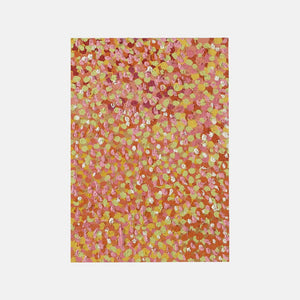
Yayoi Kusama captivated global audiences with her immersive Infinity Mirror Rooms and an unmistakable aesthetic characterised by light, polka dots and pumpkins. Rising to prominence in 1960s New York, Kusama staged provocative Happenings and exhibited her hallucinatory paintings of loops and dots known as Infinity Nets.
Her pioneering work intersected with the avant-garde, Pop and feminist art movements, and her influence extended to artists including Andy Warhol.
Major exhibitions at institutions including the Museum of Modern Art, Centre Pompidou, Tate Modern and the National Museum of Modern Art in Tokyo have celebrated her work. In 1993, Kusama represented Japan at the Venice Biennale, further establishing her international reputation. Her works have since achieved significant value on the secondary market, reflecting her enduring position within the history of contemporary art.
Throughout her extraordinary career, Kusama explored themes of infinity, repetition, perception, identity, sexuality and freedom, transforming deeply personal experiences into a distinctive and globally recognisable artistic language. In 1977, she voluntarily entered a psychiatric hospital in Tokyo, where she lived while continuing to work from a nearby studio.
Kusama died in Tokyo on 14 August 2026, aged 97, bringing to a close an extraordinary artistic life spanning more than seven decades. She continued to create until her final days, leaving behind one of the most influential and recognisable bodies of work in post-war art. Her legacy lives on through her paintings, sculptures, prints and immersive installations, which continue to invite audiences to experience the infinite through repetition, reflection and colour.
Artist notes
Kusama in brief.
Yayoi Kusama, renowned for her polka-dot installations and iconic ‘Infinity Rooms,’ stands as a pivotal figure in 20th-century art. Born in Matsumoto in 1929, Kusama has emerged as a prominent figure within both Pop Art and Minimalist movements. Her multidisciplinary approach spans performance, fashion, poetry, and painting, showcased in exhibitions worldwide.
Kusama has openly discussed using art as a therapeutic outlet, a practice she has embraced since gaining prominence in the 1960s. Her enduring legacy solidifies her position as one of the foremost contemporary artists from Japan in the 20th century.
( 01 )
Beginning
Born in Matsumoto, in Japan's Nagano region, Yayoi Kusama grew up in a family of seed farmers. Despite receiving minimal formal training, she briefly attended the Kyoto City Specialist School of Arts in 1948, though her parents did not fully support her artistic aspirations. At the age of 13, Kusama began working in a military factory, sewing parachutes for the Japanese army.
This early experience instilled in her a profound appreciation for personal freedom and creative autonomy, themes that would later underpin much of her artistic expression, marked by a deep-seated sense of escapism.
( 02 )
Early Works
As an artist, Yayoi Kusama achieved significant recognition in Japan before relocating to the United States, where she held her first solo exhibition in 1952. Initially in New York, her early commercial works were watercolours, such as "The Woman" (1953), reflecting her embrace of American artistic influences like abstraction.
This piece featured a biomorphic form adorned with dots, a motif that would become central to Kusama's entire body of work.
By 1956, Kusama expanded her artistic practice beyond gouache, watercolours, and oils on paper to include painting polka dots directly onto household surfaces, including walls and floors. During this period, she also began painting directly onto nude assistants, a practice that would define her performance art in the ensuing decade.
( 03 )
Success
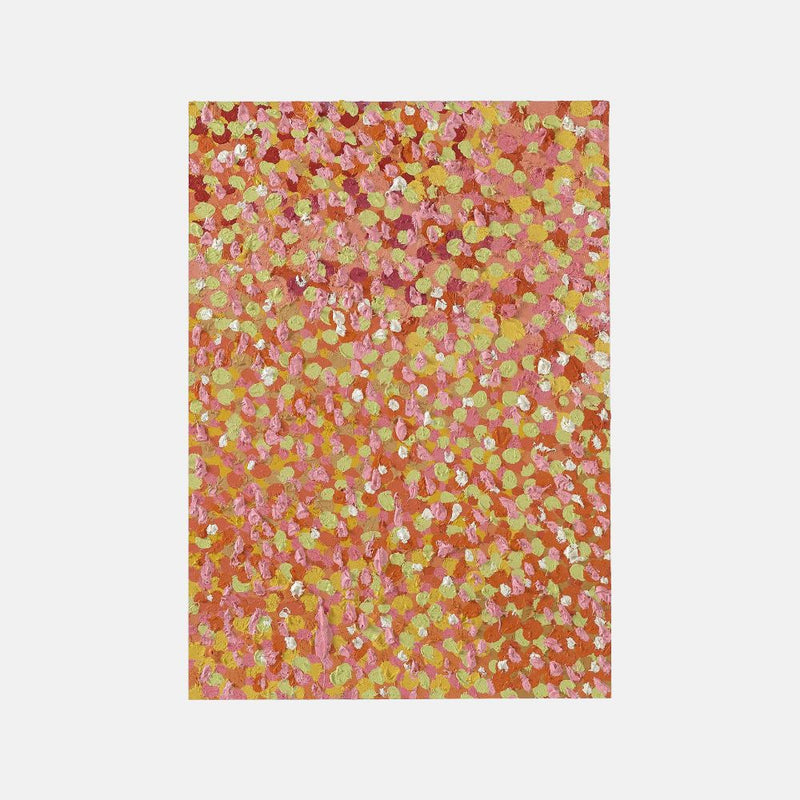
In terms of painting, Yayoi Kusama quickly became a fixture of the New York Avant Garde scene with her "Infinity Net" series, which she initiated upon her arrival in the city. These paintings, characterised by obsessively repeated marks, are recognised as a precursor to the minimalist movement. Throughout the 1960s, her work was exhibited alongside prominent figures such as Donald Judd, Andy Warhol, and Claes Oldenburg.
Kusama's first internationally acclaimed performance piece emerged in 1966 with "Narcissus Garden." Initially presented unofficially at the 33rd Biennale, the installation featured 1,500 plastic reflective globes placed on the lawn outside the Italian pavilion. Kusama personally sold these globes to visitors before the Biennale officials intervened and shut down the unauthorised exhibit.
Despite this, "Narcissus Garden" has since been recreated and exhibited in various international venues.
Yayoi Kusama Louis Vuitton
Yayoi Kusama's collaborations with major brands, particularly Louis Vuitton, have been revolutionary intersections of art and fashion. In 2012, Louis Vuitton partnered with Kusama for a ground-breaking collection that prominently featured her iconic polka dots and vibrant colours across a wide array of handbags, accessories, and apparel.
This collaboration saw Kusama's distinct aesthetic reinterpreted on Louis Vuitton's timeless designs, seamlessly blending high fashion with contemporary art.
Her whimsical motifs adorned Louis Vuitton's iconic monogram canvas, injecting her bold style into the luxury brand's legacy while captivating a global audience. The partnership garnered widespread acclaim, solidifying Kusama's stature as a cultural luminary and bridging the realms of fashion and art in a dazzling demonstration of creativity and innovation.
( 04 )
Influences
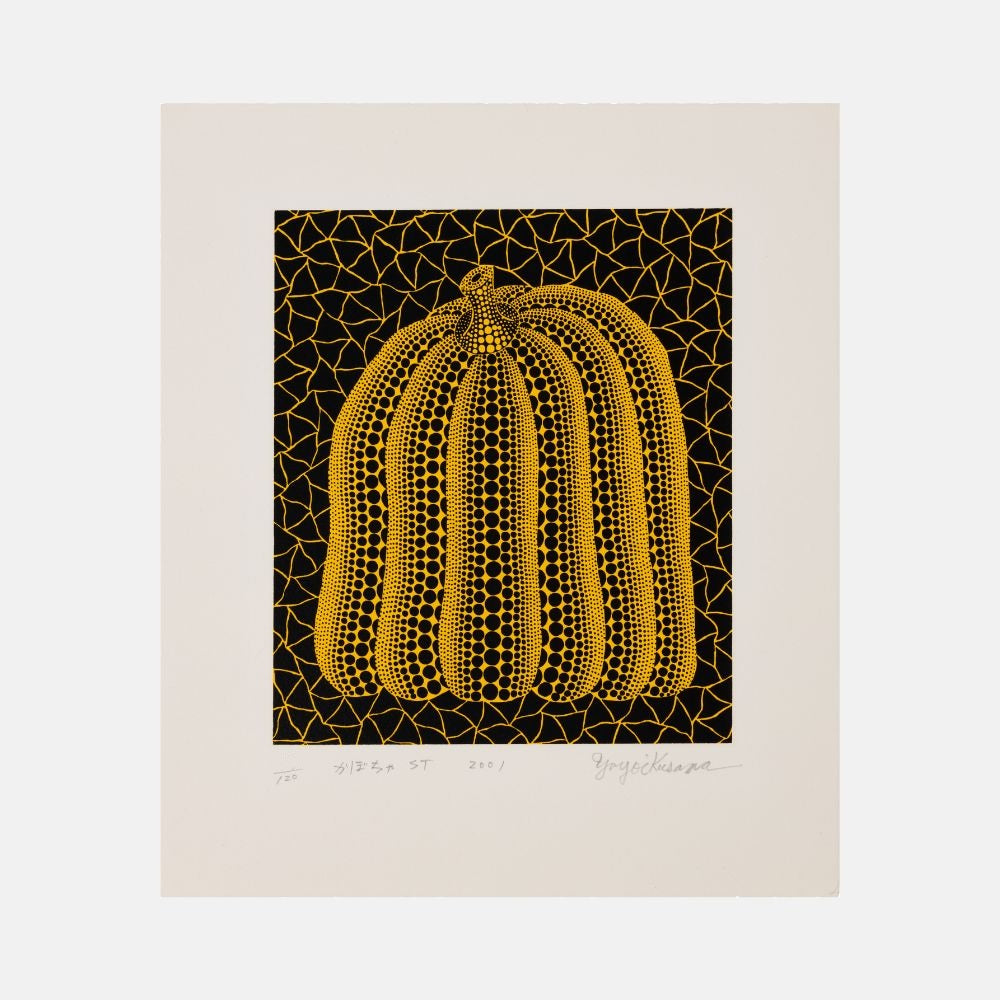
Yayoi Kusama Pumpkins
Yayoi Kusama's early experiences with hallucinations, which began in childhood, often involved visions of expansive fields of polka dots, a motif that would later define her artistic career. Similarly, her childhood fascination with drawing pumpkins also persisted as a prominent theme in her work. Describing these visions as "flashes of light, auras, or dense fields of dots," they profoundly shaped her artistic expression.
Art has been integral to Kusama's healing journey and in confronting her personal phobias, particularly evident in her 1960s 'Soft Sculptures,' notably the Accumulation series. In these works, Kusama transformed everyday household objects into provocative forms adorned with phallic shapes.
She explains that these sculptures served as a direct confrontation of her sexual anxieties, stemming from her father's infidelities during her childhood. This introspective approach not only highlights the therapeutic role of art in Kusama's life but also underscores the deeply personal and psychological underpinnings of her artistic practice.
( 05 )
Current Market
Yayoi Kusama holds the distinction of achieving the highest auction prices for any living female artist to date. Notably, her 1990 painting titled Pumpkin fetched £170,000 at Phillips auction house, while her 2006 Infinity Nets commanded £400,000 at Christie's. The record-breaking sale for Kusama, however, occurred at Sotheby's Hong Kong in 2019, where her painting Interminable Net no.4 (1959) sold for over $6.7 million.
These auction results underscore Kusama's significant influence and the enduring value placed on her ground-breaking contributions to contemporary art.
Yayoi Kusama Prints and Posters
Yayoi Kusama's prints are highly sought-after in the art market, reflecting her influential status as a leading contemporary artist. Renowned for her captivating use of polka dots, vibrant colours, and immersive installations, Kusama's prints attract collectors worldwide. Limited editions of her prints often sell out rapidly, with collectors eager to own pieces that embody Kusama's distinctive vision and aesthetic.
Spanning decades of prolific output, including her celebrated Infinity Mirror Rooms and monumental sculptures, Kusama's prints provide a accessible gateway into her expansive artistic realm. As her global popularity continues to rise, the enduring value and appeal of Kusama's prints in the art market make them prized acquisitions for both seasoned collectors and art enthusiasts alike.
( 06 )
Exhibitions
Yayoi Kusama Factory International exhibition
Yayoi Kusama's exhibitions have mesmerised audiences globally, and "You, Me, and the Balloons" was no exception. Presented by Factory International in 2023, this immersive exhibition invited visitors into Kusama's whimsical realm of polka dots, mirrors, and vibrant colours. Held in Manchester, the exhibition prominently featured Kusama's iconic balloon sculptures, which symbolise her fascination with infinity and the interconnectedness of existence.
Through these playful installations, Kusama encouraged viewers to embark on a journey of self-discovery and introspection, blurring the boundaries between reality and imagination. "You, Me, and the Balloons" provided a distinctive opportunity to delve into Kusama's enchanting universe and engage with the profound themes that echo throughout her extensive body of work.
( 07 )
Where can I buy Yayoi Kusama prints in the UK?
Lougher Contemporary, a Bristol-based secondary-market specialist since 2015, sells signed Yayoi Kusama prints and editions online and by appointment. In November 2026 our available Kusama works ran from £13,500 to £58,000, with a typical screenprint around £28,500. Most are Pumpkin, Dancing Pumpkin and other signature motifs from the 1980s to the 2000s.
( 08 )
What do the Kusama numbers in the titles mean?
Numbers such as Kusama 325 refer to the catalogue raisonné of her prints, which records each edition's title, year, medium and edition size. Quoting the number is the quickest way to confirm exactly which print you are buying or selling.
( 09 )
How are Yayoi Kusama prints authenticated?
Check for her hand signature, the edition number and the details in the catalogue raisonné. Yayoi Kusama Inc., her studio, is the authority on authenticity. Keep any studio certificate or registration card, the invoice and the provenance: they make a real difference to the price when you sell.
( 10 )
Can I sell my Yayoi Kusama print through Lougher Contemporary?
Yes. Send photographs of the front, signature and back, the catalogue raisonné number if you know it and any paperwork, and we will give you a free valuation. We can then sell the work on consignment to our collectors and trade buyers. See selling with Lougher Contemporary.
Our art sourcing service is bespoke to you. If you find the art market daunting, complex, or simply don't have the time to navigate it, we can help. By using our sourcing service you will benefit from our knowledge of contemporary art market and our trusted network of galleries and clients.
Looking for a particular work by Yayoi Kusama, or have a question about one on this page? Get in touch with the team and we will do our best to support you in your collecting journey.