

Roy Lichtenstein: The Collector's Guide to Prints, Rarity & Value
Roy Lichtenstein remains one of the defining figures of American Pop Art. His instantly recognisable visual language — bold outlines, speech bubbles, comic-strip imagery and references to commercial culture — transformed everyday imagery into sophisticated works of modern art.
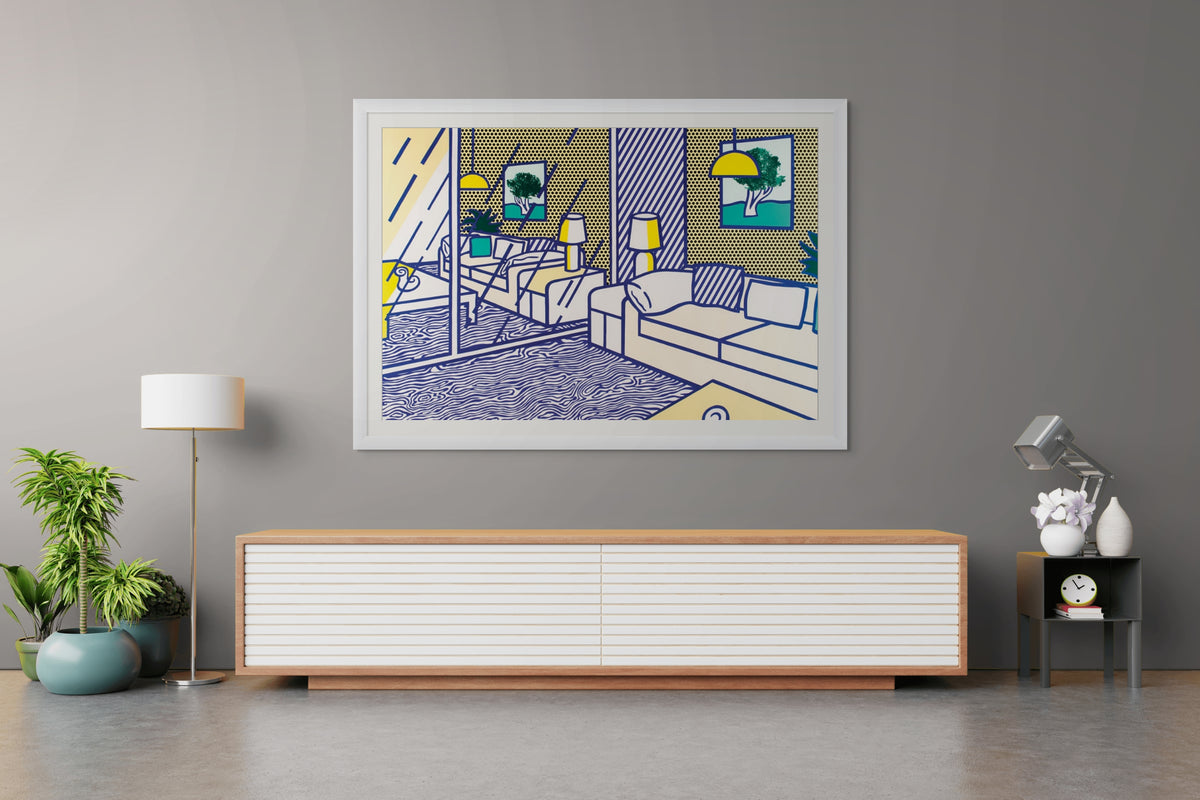
For collectors, however, there is much more to Roy Lichtenstein than the familiar comic-book compositions. Across his career, he explored landscapes, mirrors, reflections, interiors, nudes, still lifes, brushstrokes and art-historical subjects. His printmaking practice was equally diverse, encompassing lithography, screenprinting, relief printing, embossing and combinations of different techniques.
Today, Lichtenstein's prints offer collectors an unusually broad field to explore. Some works are relatively intimate, while others are monumental. Some editions are comparatively large, while others are limited to much smaller numbers. Certain images appear regularly at auction; others are considerably harder to find.
For anyone considering buying, collecting or selling a Roy Lichtenstein print, understanding the differences between these works is essential.
Looking to sell a Roy Lichtenstein? We are currently seeking works by the artist for collectors and clients.
Who Was Roy Lichtenstein?
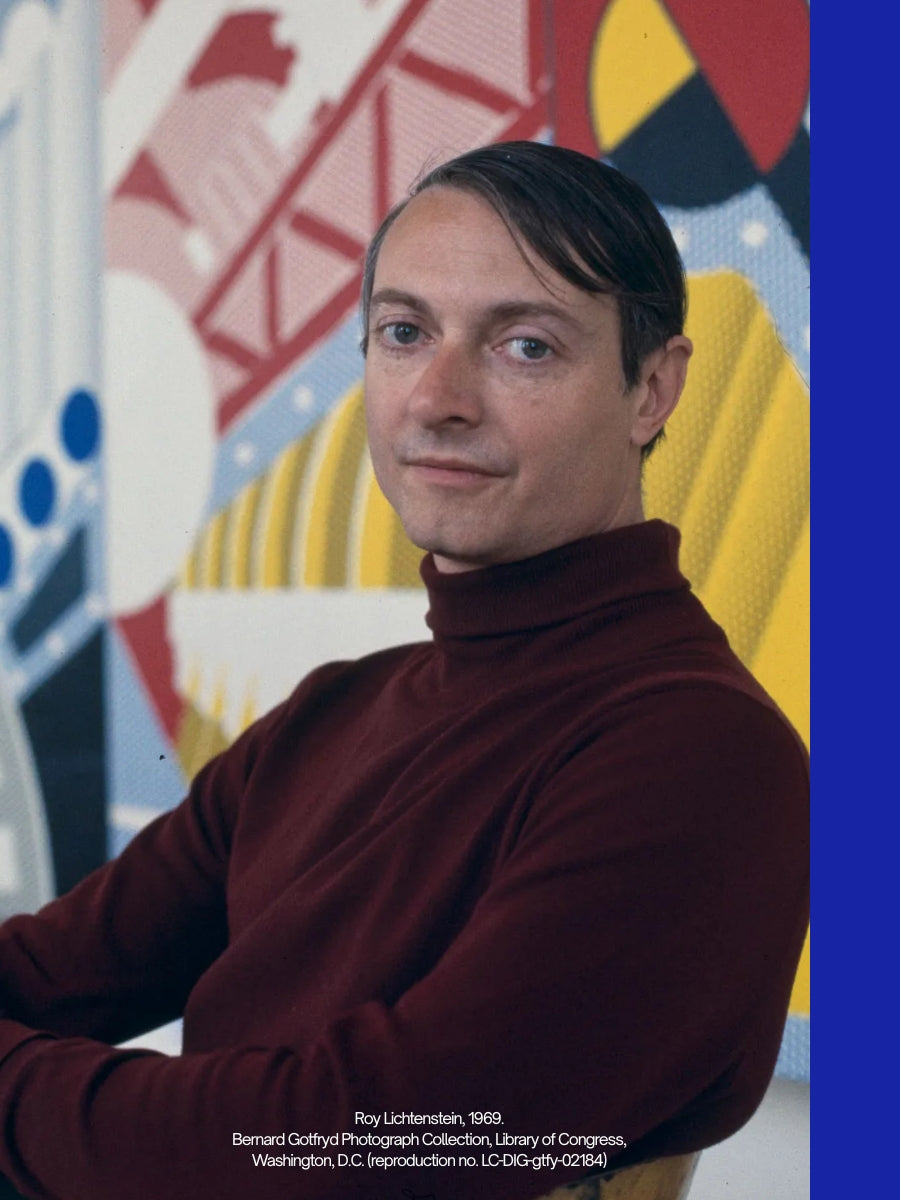
Roy Lichtenstein (1923–1997) was an American artist whose work became closely associated with the Pop Art movement.
Born in New York in 1923, Lichtenstein developed a visual language that deliberately blurred the distinction between high art and popular culture. His paintings and prints drew on commercial graphics, advertising, comic books, art history and other forms of mass-produced imagery.
Rather than simply reproducing these sources, Lichtenstein transformed them.
His enlarged compositions, restricted colour palettes and characteristic Ben-Day dots created images that appeared mechanically produced while being carefully constructed by the artist.
This tension between the apparently mechanical and the highly deliberate became one of the defining characteristics of his work.
Although Lichtenstein is perhaps best known for his comic-inspired paintings, his career was considerably broader. His work encompassed paintings, drawings, sculptures, collages and an extensive body of prints.
The Roy Lichtenstein Foundation's digital catalogue raisonné provides an extensive record of his known works and includes dedicated documentation of his print practice.
Why Are Roy Lichtenstein Prints Important?
Printmaking was not simply a secondary activity within Lichtenstein's career.
The artist collaborated with specialist printers and publishers to explore techniques that allowed him to translate his visual language into new materials and formats.
The resulting works demonstrate how Lichtenstein repeatedly tested the possibilities of reproduction.
Screenprinting allowed him to work with flat areas of colour and highly controlled graphic forms. Lithography offered another way of translating his imagery, while relief printing, embossing, collage and other processes introduced physical and visual qualities that could not be achieved through a straightforward reproduction.
The Foundation's catalogue documents hundreds of editioned prints and posters associated with Lichtenstein's practice, alongside related works and research material.
For collectors, this means that the category of "Roy Lichtenstein prints" encompasses a remarkably diverse range of works.
What Makes a Roy Lichtenstein Print Valuable?
There is no single factor that determines the value of a Roy Lichtenstein print.
Collectors and the market may consider a combination of factors, including the image, date, series, medium, edition, condition, provenance and exhibition history.
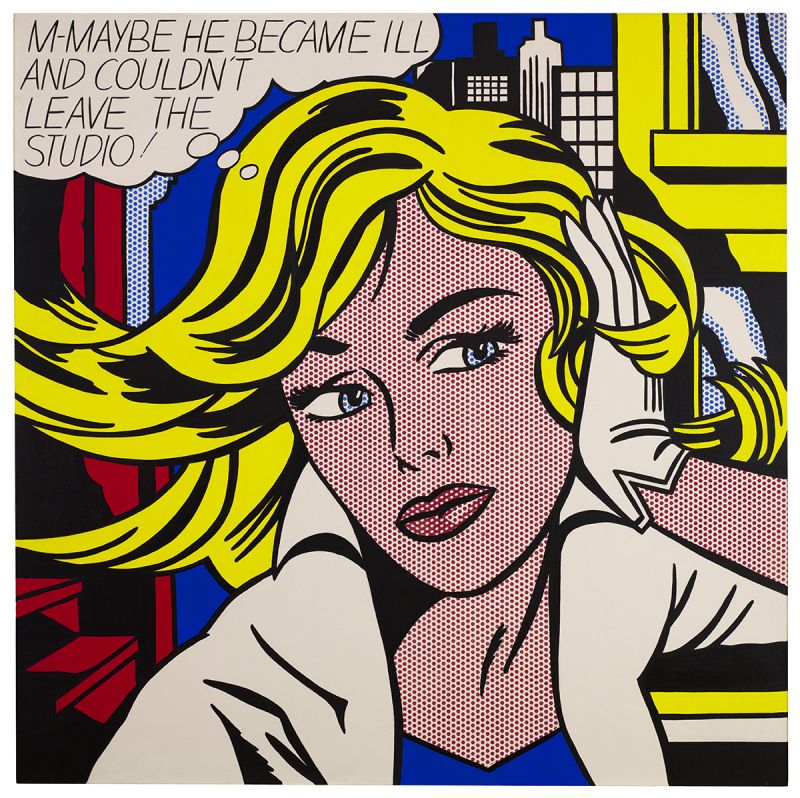
The Image
The particular image is one of the most important considerations.
Lichtenstein's most recognisable visual motifs can command considerable attention, but popularity is not simply a question of whether an image is immediately recognisable.
Different periods and series appeal to different collectors.
A dramatic comic-book composition may have a very different market profile from a later work from the Reflections, Nudes or Water Lilies series.
The Series
Lichtenstein returned repeatedly to particular subjects and ideas.
Important print-related areas include:
• early Pop imagery
• comic-book compositions
• Brushstrokes
• Mirrors
• Reflections
• Interiors
• Landscapes
• Water Lilies
• Nudes
• still lifes
• art-historical subjects
Understanding the context of a particular work can therefore be just as important as looking at the image in isolation.
Edition Size
Edition size is another important consideration.
A print might belong to a numbered edition alongside a separate group of artist's proofs or other proofs.
For example, ... HUH? from 1976 was produced as an edition of 100, plus 20 artist's proofs. The Roy Lichtenstein Foundation records it as a screenprint on Arches paper measuring approximately 105.6 × 75.4 cm at the sheet level.
By contrast, Water Lily Pond with Reflections from 1992 was produced as an edition of 23, alongside artist's proofs and other proofs.
Edition size alone does not determine value, but it provides important context.
Scale
Size can be particularly interesting when considering Lichtenstein's later print practice.
Some works are comparatively compact, while others are genuinely monumental.
Reflections on Girl, for example, has an image size of approximately 98.2 × 123.7 cm and a sheet size of approximately 114.5 × 139 cm.
Phillips has recorded multiple auction results for impressions of the work, including a sale at £162,500 and another at $203,200.
Large-scale works can therefore represent a particularly distinctive area of Lichtenstein collecting.
Medium and Technique
Two prints depicting related imagery can nevertheless be materially very different.
Collectors should look at whether a work is:
• a screenprint
• lithograph
• relief print
• woodcut
• embossing
• mixed technique
• or a combination of processes
Some Lichtenstein prints deliberately combine several techniques.
Reflections on Girl, for example, combines lithography, screenprinting and relief with metallised PVC collage and embossing.
Condition
Condition is an important part of any print valuation.
Collectors should consider:
• fading
• paper discoloration
• foxing
• staining
• handling marks
• tears
• creases
• abrasions
• restoration
• mounting
• framing
• the condition of the margins
Large works can present particular conservation and framing considerations simply because of their physical scale.
Provenance
Provenance refers to the documented history of ownership of a work.
Relevant information might include:
• the original gallery or publisher
• previous owners
• exhibition history
• auction history
• invoices
• certificates
• catalogue references
• correspondence
• estate information
Strong provenance can help establish a work's history and may be particularly important when assessing a significant or unusual example.
Catalogue Raisonné Reference
A catalogue raisonné is an important research tool for collectors.
The Roy Lichtenstein Foundation's digital catalogue assigns works RLCR numbers and provides information about individual works, including medium, dimensions, edition details and provenance where documented.
When researching a Lichtenstein, identifying the precise work rather than relying solely on a title or image is therefore essential.
The Image
The particular image is one of the most important considerations.
Lichtenstein's most recognisable visual motifs can command considerable attention, but popularity is not simply a question of whether an image is immediately recognisable.
Different periods and series appeal to different collectors.
A dramatic comic-book composition may have a very different market profile from a later work from the Reflections, Nudes or Water Lilies series.
The Series
Lichtenstein returned repeatedly to particular subjects and ideas.
Important print-related areas include:
• early Pop imagery
• comic-book compositions
• Brushstrokes
• Mirrors
• Reflections
• Interiors
• Landscapes
• Water Lilies
• Nudes
• still lifes
• art-historical subjects
Understanding the context of a particular work can therefore be just as important as looking at the image in isolation.
Edition Size
Edition size is another important consideration.
A print might belong to a numbered edition alongside a separate group of artist's proofs or other proofs.
For example, ... HUH? from 1976 was produced as an edition of 100, plus 20 artist's proofs. The Roy Lichtenstein Foundation records it as a screenprint on Arches paper measuring approximately 105.6 × 75.4 cm at the sheet level.
By contrast, Water Lily Pond with Reflections from 1992 was produced as an edition of 23, alongside artist's proofs and other proofs.
Edition size alone does not determine value, but it provides important context.
Scale
Size can be particularly interesting when considering Lichtenstein's later print practice.
Some works are comparatively compact, while others are genuinely monumental.
Reflections on Girl, for example, has an image size of approximately 98.2 × 123.7 cm and a sheet size of approximately 114.5 × 139 cm.
Phillips has recorded multiple auction results for impressions of the work, including a sale at £162,500 and another at $203,200.
Large-scale works can therefore represent a particularly distinctive area of Lichtenstein collecting.
Medium and Technique
Two prints depicting related imagery can nevertheless be materially very different.
Collectors should look at whether a work is:
• a screenprint
• lithograph
• relief print
• woodcut
• embossing
• mixed technique
• or a combination of processes
Some Lichtenstein prints deliberately combine several techniques.
Reflections on Girl, for example, combines lithography, screenprinting and relief with metallised PVC collage and embossing.
Condition
Condition is an important part of any print valuation.
Collectors should consider:
• fading
• paper discoloration
• foxing
• staining
• handling marks
• tears
• creases
• abrasions
• restoration
• mounting
• framing
• the condition of the margins
Large works can present particular conservation and framing considerations simply because of their physical scale.
Provenance
Provenance refers to the documented history of ownership of a work.
Relevant information might include:
• the original gallery or publisher
• previous owners
• exhibition history
• auction history
• invoices
• certificates
• catalogue references
• correspondence
• estate information
Strong provenance can help establish a work's history and may be particularly important when assessing a significant or unusual example.
Catalogue Raisonné Reference
A catalogue raisonné is an important research tool for collectors.
The Roy Lichtenstein Foundation's digital catalogue assigns works RLCR numbers and provides information about individual works, including medium, dimensions, edition details and provenance where documented.
When researching a Lichtenstein, identifying the precise work rather than relying solely on a title or image is therefore essential.
Important Roy Lichtenstein Print Series
Reflections
Reflections by Roy Lichenstein
Lichtenstein's Reflections series is one of the most visually distinctive areas of his later practice.
Beginning in the late 1980s, Lichtenstein developed compositions in which familiar images appear partially obscured by reflective streaks, as though seen through glass or reflected in a mirror.
The Foundation's print catalogue documents a group of seven Reflections prints begun at Tyler Graphics in 1989, combining lithography, screenprinting, relief, collage and embossing.
The series demonstrates Lichtenstein's continued interest in taking a familiar visual language and making it deliberately unstable.
For collectors, the combination of scale, complexity and relatively limited editions makes works from the series particularly interesting.
Water Lilies
Water Lilies by Roy Lichenstein
Lichtenstein's Water Lilies works offer a fascinating example of his engagement with art history.
The subject immediately recalls Claude Monet, but Lichtenstein translated the traditional Impressionist motif into his own highly stylised Pop vocabulary.
The resulting works combine the visual language of Ben-Day dots and graphic reproduction with the subject of the water-lily pond.
One particularly striking example is Water Lily Pond with Reflections, 1992.
The Roy Lichtenstein Foundation records the work as a screenprinted enamel on processed and swirled stainless steel, measuring approximately 147.3 × 214.6 cm framed. The edition consisted of 23 works, alongside seven artist's proofs and other proofs.
This combination of enormous scale, unusual support and limited edition makes the Water Lilies series an important area for collectors interested in Lichtenstein's later work.
Nudes
Nudes by Roy Lichenstein
The Nudes series represents another significant late development in Lichtenstein's work.
Rather than simply returning to his earlier comic-book imagery, Lichtenstein used the language of Pop Art to explore the figure and domestic interiors.
Roommates, from the Nudes series, is a particularly striking example.
The 1994 work is a monumental relief print measuring approximately 145.4 × 114.3 cm at the image level, with an edition of 40 plus 10 artist's proofs.
Phillips has recorded auction results for impressions of Roommates, including a sale for $317,500 and another artist's proof for $428,400.
Such results illustrate why individual works should always be assessed on their own characteristics rather than relying on a single generic "Roy Lichtenstein price".
Reflections by Roy Lichenstein
Lichtenstein's Reflections series is one of the most visually distinctive areas of his later practice.
Beginning in the late 1980s, Lichtenstein developed compositions in which familiar images appear partially obscured by reflective streaks, as though seen through glass or reflected in a mirror.
The Foundation's print catalogue documents a group of seven Reflections prints begun at Tyler Graphics in 1989, combining lithography, screenprinting, relief, collage and embossing.
The series demonstrates Lichtenstein's continued interest in taking a familiar visual language and making it deliberately unstable.
For collectors, the combination of scale, complexity and relatively limited editions makes works from the series particularly interesting.
Water Lilies by Roy Lichenstein
Lichtenstein's Water Lilies works offer a fascinating example of his engagement with art history.
The subject immediately recalls Claude Monet, but Lichtenstein translated the traditional Impressionist motif into his own highly stylised Pop vocabulary.
The resulting works combine the visual language of Ben-Day dots and graphic reproduction with the subject of the water-lily pond.
One particularly striking example is Water Lily Pond with Reflections, 1992.
The Roy Lichtenstein Foundation records the work as a screenprinted enamel on processed and swirled stainless steel, measuring approximately 147.3 × 214.6 cm framed. The edition consisted of 23 works, alongside seven artist's proofs and other proofs.
This combination of enormous scale, unusual support and limited edition makes the Water Lilies series an important area for collectors interested in Lichtenstein's later work.
Nudes by Roy Lichenstein
The Nudes series represents another significant late development in Lichtenstein's work.
Rather than simply returning to his earlier comic-book imagery, Lichtenstein used the language of Pop Art to explore the figure and domestic interiors.
Roommates, from the Nudes series, is a particularly striking example.
The 1994 work is a monumental relief print measuring approximately 145.4 × 114.3 cm at the image level, with an edition of 40 plus 10 artist's proofs.
Phillips has recorded auction results for impressions of Roommates, including a sale for $317,500 and another artist's proof for $428,400.
Such results illustrate why individual works should always be assessed on their own characteristics rather than relying on a single generic "Roy Lichtenstein price".
Five Roy Lichtenstein Prints to Know
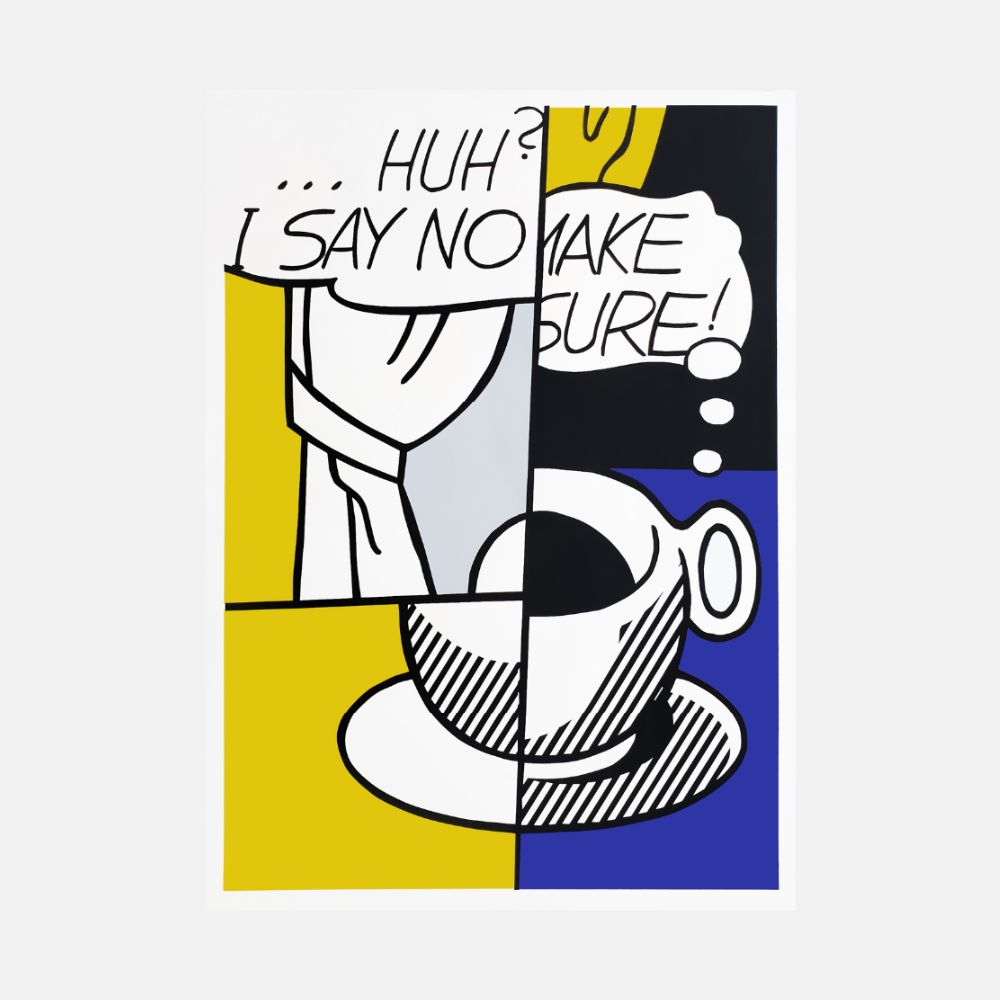
... HUH?, 1976
... HUH? is a strong example of Lichtenstein's ability to take comic-strip language and turn it into a large-scale graphic composition.
The 1976 screenprint was produced in an edition of 100, plus 20 artist's proofs.
The work measures approximately 105.6 × 75.4 cm at sheet level.
Why collectors should look at it: its scale, immediately recognisable graphic language and connection to Lichtenstein's comic-inspired imagery make it an important example of his 1970s print practice.
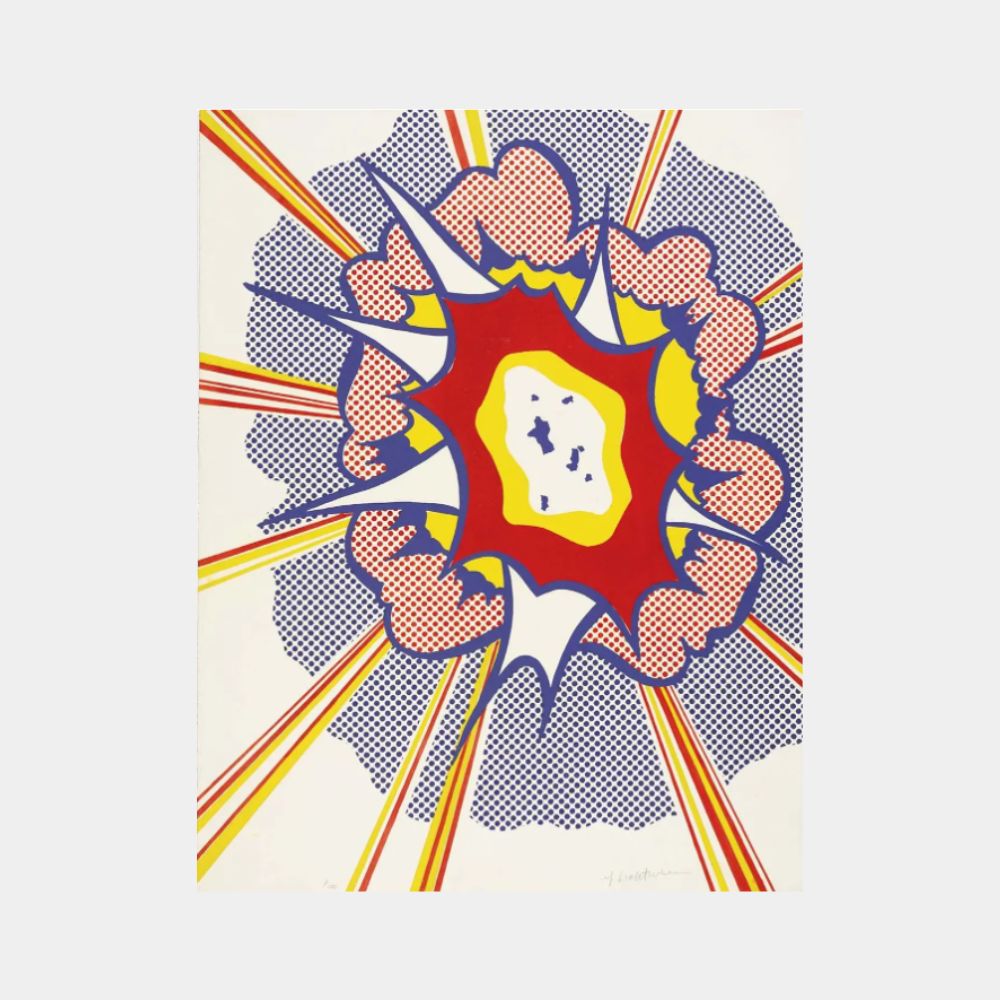
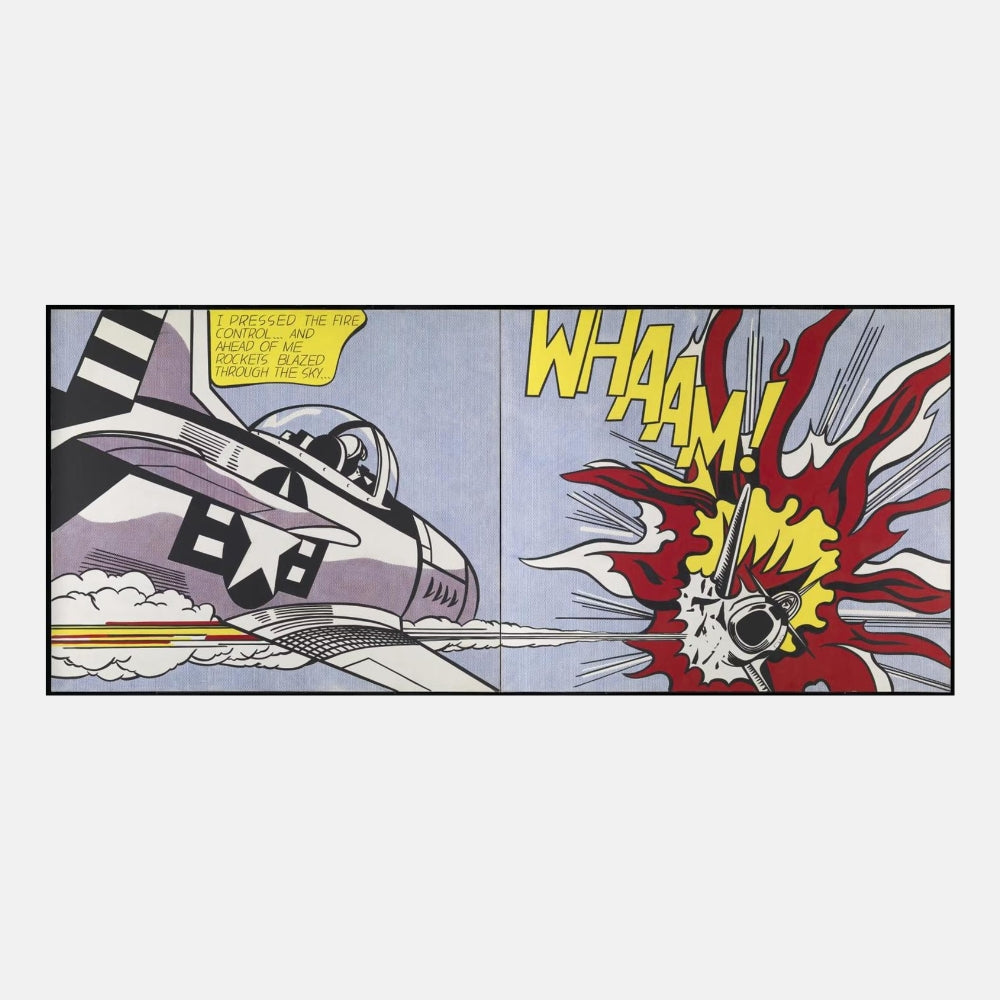
Explosion, 1967
Explosion dates from the height of Lichtenstein's early Pop period.
The Roy Lichtenstein Foundation records the work as a lithograph on Rives paper, measuring approximately 56 × 43.1 cm.
It was produced in an edition of 100, with additional proofs.
The work's explosive graphic composition demonstrates Lichtenstein's ability to translate the visual language of commercial printing into fine-art printmaking.
Why collectors should look at it: it belongs to an important period in Lichtenstein's development and provides a clear connection between his comic-book source material and his print practice.
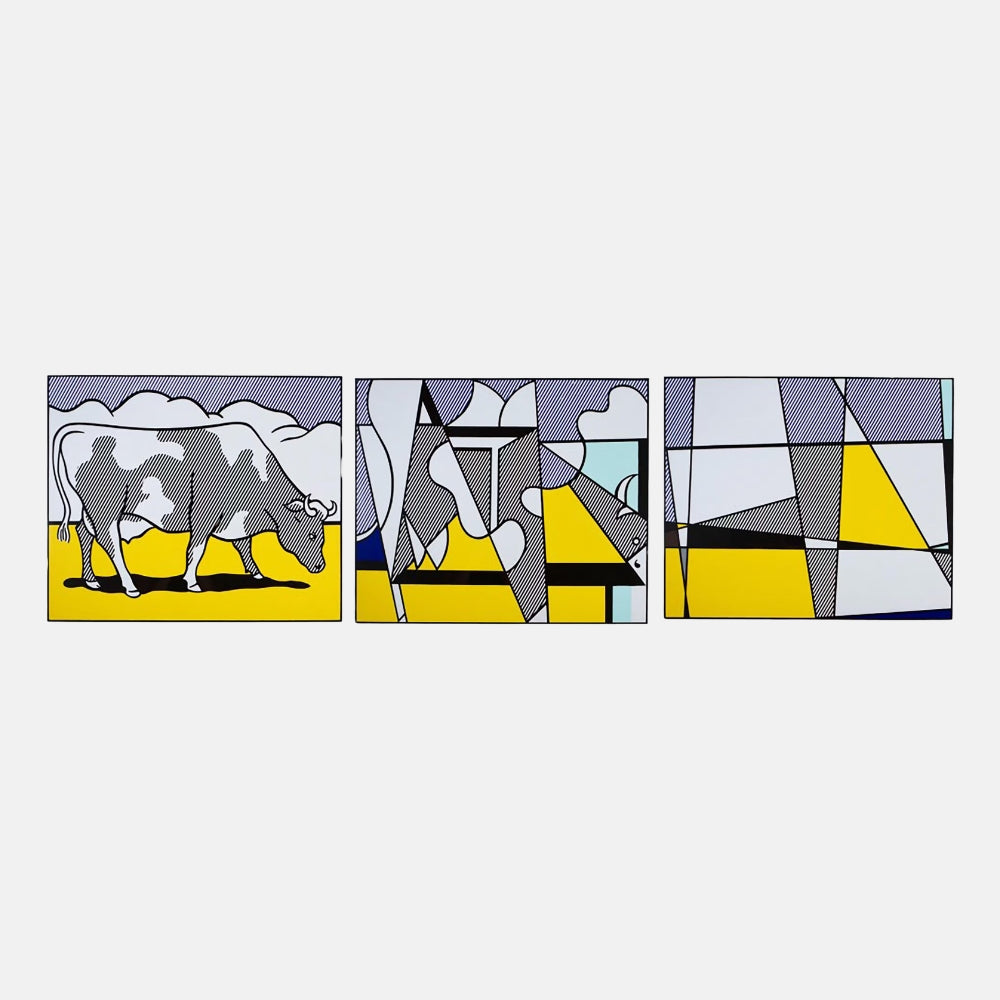
Cow Triptych
Lichtenstein's fascination with cows and the transformation of recognisable imagery into simplified graphic form provides another fascinating area for collectors.
His Cow Triptych (Cow Going Abstract) dates from 1974 and consists of three large panels.
The work is an example of how Lichtenstein could take an apparently straightforward subject and progressively reduce and transform its visual information.
The subject also demonstrates his broader interest in abstraction and the relationship between recognisable imagery and graphic simplification.
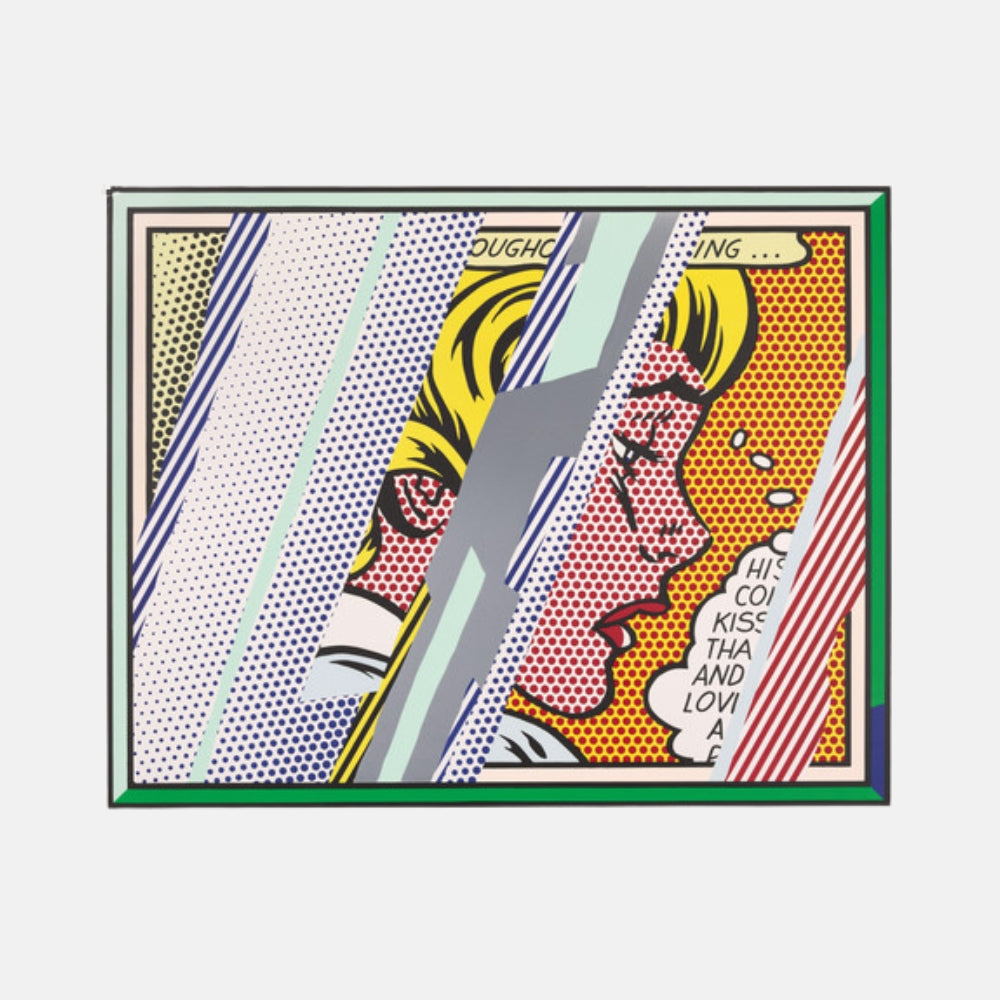
Reflections on Girl, 1990
Reflections on Girl is one of the standout examples of Lichtenstein's later Reflections imagery.
The work combines lithography, screenprinting and relief with metallised PVC collage and embossing.
Its image measures approximately 98.2 × 123.7 cm, while the sheet measures approximately 114.5 × 139 cm.
Phillips has recorded several auction results for impressions of the work, including £162,500 and $203,200.
Why collectors should look at it: it combines an immediately recognisable Lichtenstein figure with an unusually complex printmaking process and substantial physical scale.
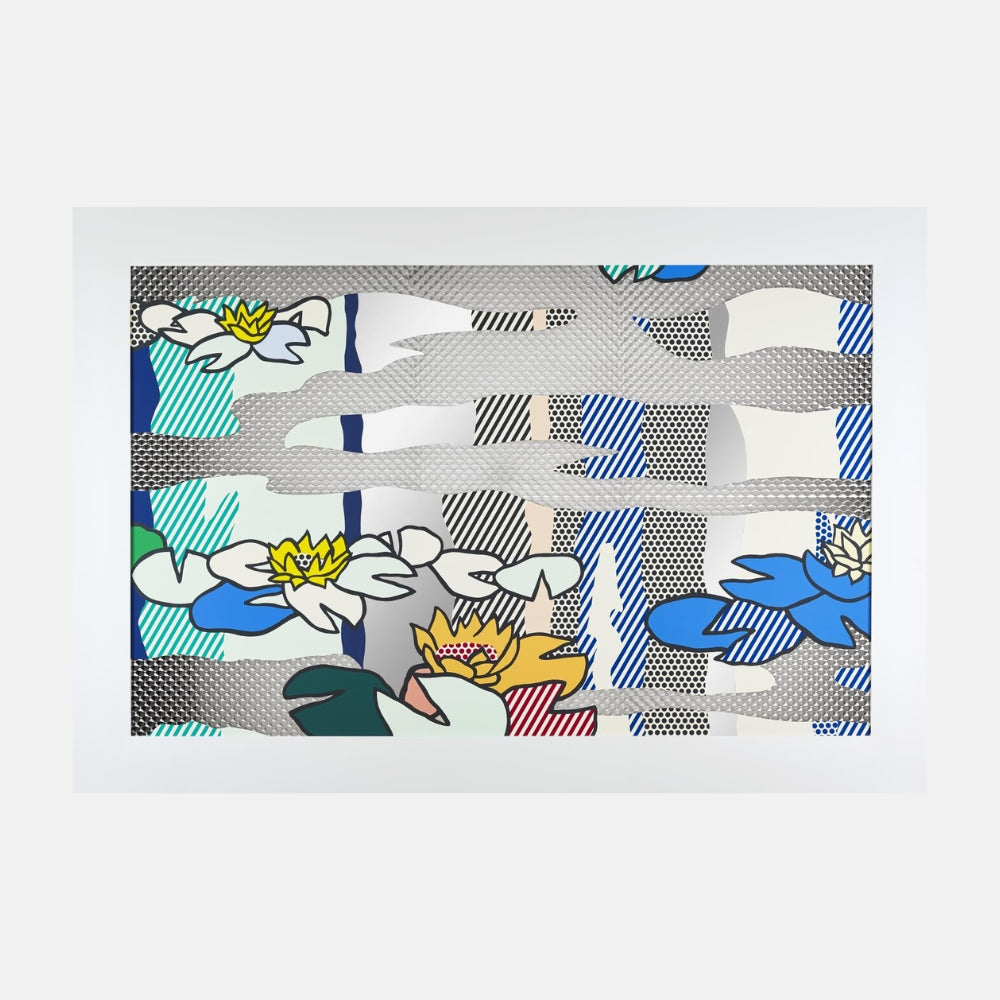
Water Lily Pond with Reflections, 1992
This later work demonstrates just how far Lichtenstein moved beyond the comic-book imagery with which he is most commonly associated.
Water Lily Pond with Reflections is a screenprinted enamel work on processed and swirled stainless steel.
The Foundation records an edition of 23, plus artist's proofs and other proofs, with framed dimensions of approximately 147.3 × 214.6 cm.
Sotheby's has offered an artist's proof from the artist's estate at auction.
Why collectors should look at it: its scale, unusual metallic support, limited edition and engagement with Monet make it a particularly distinctive example of Lichtenstein's mature print practice.
Large-Format Roy Lichtenstein Prints
Large-format Lichtenstein works deserve particular attention.
Scale changes the experience of the work.
A Lichtenstein print measuring more than a metre across has an entirely different physical presence from a smaller edition.
Some later works push this even further.
Water Lily Pond with Reflections measures approximately 147.3 × 214.6 cm framed, while Roommates measures approximately 162.6 × 129.5 cm at sheet level.
Large-format works can therefore be among the most visually impressive examples available to collectors.
They can also be less straightforward to handle, frame, transport and display, which makes condition and provenance particularly important when buying or selling.
Lougher's specialists can help advise on collecting Roy Lichenstein works, just get in touch with our team here.
... HUH?, 1976
... HUH? is a strong example of Lichtenstein's ability to take comic-strip language and turn it into a large-scale graphic composition.
The 1976 screenprint was produced in an edition of 100, plus 20 artist's proofs.
The work measures approximately 105.6 × 75.4 cm at sheet level.
Why collectors should look at it: its scale, immediately recognisable graphic language and connection to Lichtenstein's comic-inspired imagery make it an important example of his 1970s print practice.
Explosion, 1967
Explosion dates from the height of Lichtenstein's early Pop period.
The Roy Lichtenstein Foundation records the work as a lithograph on Rives paper, measuring approximately 56 × 43.1 cm.
It was produced in an edition of 100, with additional proofs.
The work's explosive graphic composition demonstrates Lichtenstein's ability to translate the visual language of commercial printing into fine-art printmaking.
Why collectors should look at it: it belongs to an important period in Lichtenstein's development and provides a clear connection between his comic-book source material and his print practice.
Cow Triptych
Lichtenstein's fascination with cows and the transformation of recognisable imagery into simplified graphic form provides another fascinating area for collectors.
His Cow Triptych (Cow Going Abstract) dates from 1974 and consists of three large panels.
The work is an example of how Lichtenstein could take an apparently straightforward subject and progressively reduce and transform its visual information.
The subject also demonstrates his broader interest in abstraction and the relationship between recognisable imagery and graphic simplification.
Reflections on Girl, 1990
Reflections on Girl is one of the standout examples of Lichtenstein's later Reflections imagery.
The work combines lithography, screenprinting and relief with metallised PVC collage and embossing.
Its image measures approximately 98.2 × 123.7 cm, while the sheet measures approximately 114.5 × 139 cm.
Phillips has recorded several auction results for impressions of the work, including £162,500 and $203,200.
Why collectors should look at it: it combines an immediately recognisable Lichtenstein figure with an unusually complex printmaking process and substantial physical scale.
Water Lily Pond with Reflections, 1992
This later work demonstrates just how far Lichtenstein moved beyond the comic-book imagery with which he is most commonly associated.
Water Lily Pond with Reflections is a screenprinted enamel work on processed and swirled stainless steel.
The Foundation records an edition of 23, plus artist's proofs and other proofs, with framed dimensions of approximately 147.3 × 214.6 cm.
Sotheby's has offered an artist's proof from the artist's estate at auction.
Why collectors should look at it: its scale, unusual metallic support, limited edition and engagement with Monet make it a particularly distinctive example of Lichtenstein's mature print practice.
Large-Format Roy Lichtenstein Prints
Large-format Lichtenstein works deserve particular attention.
Scale changes the experience of the work.
A Lichtenstein print measuring more than a metre across has an entirely different physical presence from a smaller edition.
Some later works push this even further.
Water Lily Pond with Reflections measures approximately 147.3 × 214.6 cm framed, while Roommates measures approximately 162.6 × 129.5 cm at sheet level.
Large-format works can therefore be among the most visually impressive examples available to collectors.
They can also be less straightforward to handle, frame, transport and display, which makes condition and provenance particularly important when buying or selling.
Lougher's specialists can help advise on collecting Roy Lichenstein works, just get in touch with our team here.
How Much Is a Roy Lichtenstein Print Worth?
There is no single price for a Roy Lichtenstein print.
The value of a particular work depends on its individual characteristics and the circumstances of the market at the time it is offered.
Two works by the same artist can sell for dramatically different prices.
Factors that may influence Roy Lichenstein prints prices:
• the specific image
• date
• series
• medium
• edition size
• whether it is a numbered impression or artist's proof
• condition
• provenance
• exhibition history
• previous auction results
• current collector demand
Auction results can provide useful market evidence, but they should not be treated as a guaranteed valuation for another impression.
For example, Phillips has recorded Reflections on Girl selling for £162,500 in one sale and $203,200 in another. Roommates has also achieved different results at auction.
This variation demonstrates why a professional valuation should consider the individual work rather than simply applying an average price to the artist.
How to Tell Which Roy Lichtenstein Print You Own
If you own a Lichtenstein and are considering selling it, start by gathering as much information as possible.
Get in touch with our consignment team to get a valuation of your artwork.
Is the work signed? Where is it signed?
For example, a work might be numbered 30/68.
This can provide useful information about the edition.
Look for an RLCR or Corlett catalogue number where available.
Photograph the front, reverse, margins and frame.
Read our guide to condition checking and cataloguing your artwork here.
Gather invoices, certificates, gallery documentation and previous sale records.
Record both image and sheet dimensions where applicable.
If you're unsure what you have, photographs of the front and reverse of the work, together with any paperwork, can provide a useful starting point for an initial assessment.
Read our guide to photographing and cataloguing your artwork here.
How to Sell a Roy Lichtenstein Print
If you own a Roy Lichtenstein and are considering selling, the first step is to establish exactly what you have.
A specialist valuation can consider the work's identity, edition, condition, provenance and relevant market evidence.
Depending on the work, a sale may be appropriate through private sale, a specialist dealer or auction.
For collectors who prefer a managed sale, consignment can provide a way to place the work with a specialist while retaining ownership until it sells.
We Are Looking for Roy Lichtenstein Works
We are currently seeking Roy Lichtenstein prints and works on paper for collectors and clients.
We are particularly interested in hearing from owners of:
• rare Lichtenstein prints
• large-format works
• works from important print series
• Reflections
• Nudes
• Water Lilies
• early Pop imagery
• signed and numbered editions
• works with strong provenance
You do not need to have already decided to sell.
If you would like to discuss a work confidentially, our team can advise on the next steps.
Looking for a Roy Lichtenstein?
We can also help collectors looking for particular works.
If you are searching for a specific image, series, edition or large-format Lichtenstein that is not currently available, let us know.
Explore Lougher's Sourcing service
Our sourcing service can help connect collectors with works available through our network.
Roy Lichtenstein's print practice is considerably broader than the familiar comic-book imagery for which he is best known.
From Explosion and ... HUH? to the monumental Reflections, Nudes and Water Lilies works, his prints demonstrate an extraordinary range of techniques, subjects and scales.
For collectors, that breadth creates a rich field to explore.
For owners considering selling, it also means that identifying the precise work is essential.
If you own a Roy Lichtenstein and would like to discuss its value or potential sale, we would be pleased to hear from you.
FAQ
Use this text to share information about your product or shipping policies.
Do you ship overseas?
Yes, we ship all over the world. Shipping costs will apply, and will be added at checkout. We run discounts and promotions all year, so stay tuned for exclusive deals.
How long will it take to get my orders?
It depends on where you are. Orders processed here will take 5-7 business days to arrive. Overseas deliveries can take anywhere from 7-16 days. Delivery details will be provided in your confirmation email.
Any question?
You can contact us through our contact page! We will be happy to assist you.