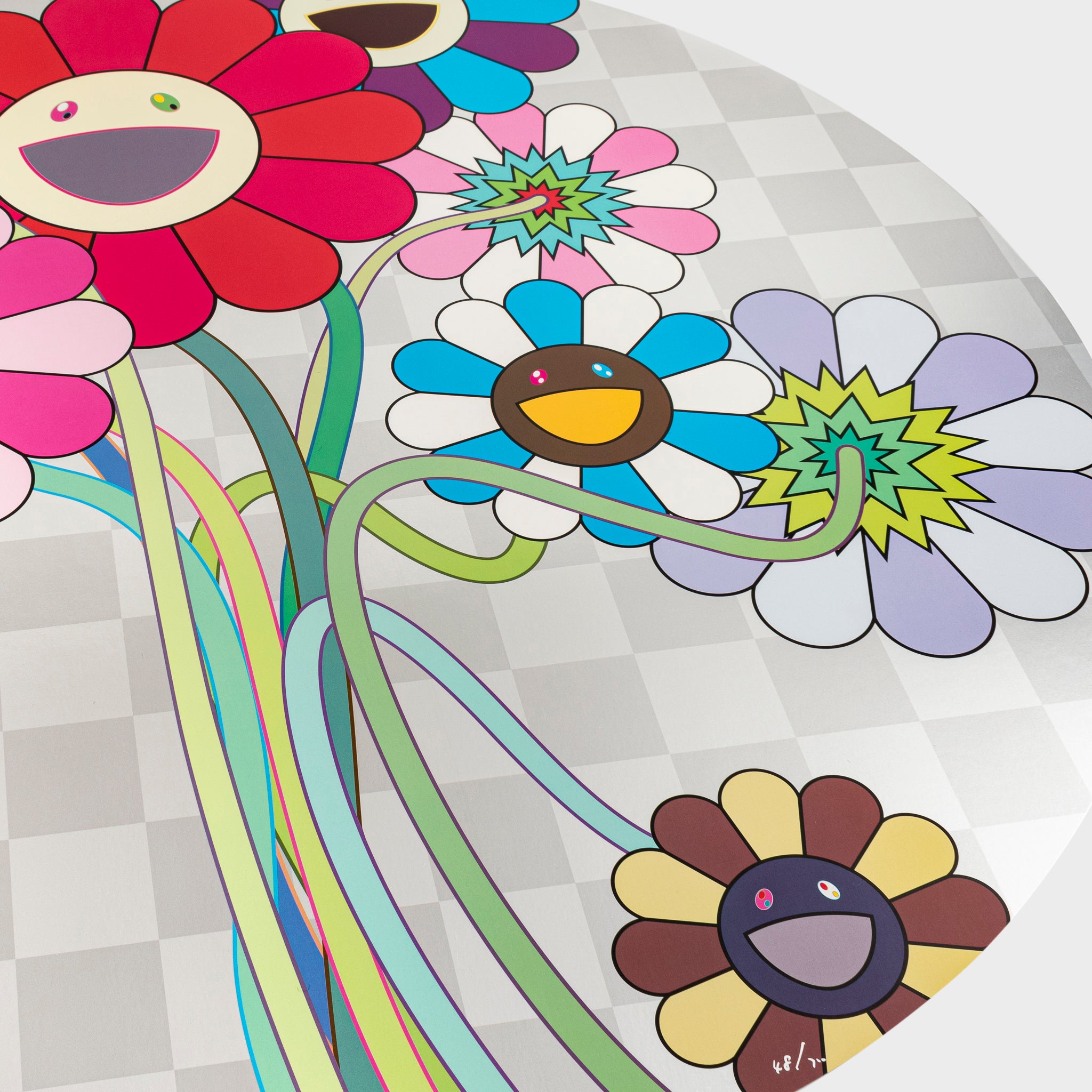
Flowers: Takashi Murakami’s signature flowers, particularly the smiling daisies, are among his most iconic motifs. These cheerful yet slightly unsettling blooms appear in a wide range of his works, from large canvases to sculptures and commercial products. They symbolise both the joy and sadness inherent in life, embodying the artists unique blend of traditional Japanese aesthetics with contemporary pop culture.
Doraemon: Murakami often references popular Japanese characters in his art, including Doraemon, a beloved robotic cat from a classic manga and anime series. By incorporating Doraemon into his works, Murakami bridges the gap between traditional Japanese culture and modern media, infusing his art with a sense of nostalgia and cultural commentary.
Mr. DOB: Mr. DOB is one of Murakami’s most recognisable creations, often regarded as his alter ego. With Mickey Mouse-like ears and a round, cartoonish face, Mr. DOB shifts between cute and menacing, reflecting his exploration of the dualities within consumer culture. The character is a critique of capitalist consumerism, parodying the ubiquitous mascots of modern life.
100 Views of Edo: Inspired by Utagawa Hiroshige’s 19th-century series 100 Famous Views of Edo, Murakami has created modern interpretations that engage with the historical and cultural significance of Edo (now Tokyo). His works in this series juxtapose the traditional ukiyo-e style with contemporary elements, highlighting the ongoing influence of Japanese art history on his practice.
Hiropon Factory & Kaikai Kiki
In the mid-1990s, Takashi Murakami established the Hiropon Factory in Tokyo, a studio modelled after Andy Warhol’s Factory. This space allowed Murakami to produce his large-scale works with the help of assistants and also provided a platform for emerging artists. The Hiropon Factory later evolved into Kaikai Kiki Co., Ltd., expanding Murakami’s influence in the global art scene.
Kaikai Kiki now operates in Tokyo, New York, and Los Angeles, serving as a production hub and artist management company. The collective plays a crucial role in promoting the superflat style—a movement Murakami spearheaded, which flattens distinctions between high and low culture.
Japanese Influences
Takashi Murakami’s work is deeply rooted in Japanese culture, drawing inspiration from traditional Japanese painting, or nihonga, which he studied extensively at the Tokyo University of the Arts. His art often references historical Japanese artists like Kanō Eitoku, whose powerful and sensitive qualities Murakami seeks to emulate.
Murakami's superflat aesthetic also reflects the influence of Japanese art and culture, merging ancient techniques with contemporary pop culture elements such as anime, manga, and otaku subculture. This synthesis of old and new creates a dialogue between Japan’s artistic heritage and modern-day visual culture.
Collaborations
Takashi Murakami x Louis Vuitton: In the early 2000s, Murakami collaborated with Marc Jacobs, then creative director of Louis Vuitton, to reimagine the brand’s classic monogram. This ground-breaking collaboration not only revitalised the Louis Vuitton brand but also brought Murakami international acclaim, solidifying his status as a cultural icon.
Takashi Murakami x T-Shirts: Murakami’s designs have also made their way into the world of fashion through collaborations on T-shirt collections. Notably, his partnership with Billie Eilish for a Uniqlo UT collection merged the worlds of music, art, and fashion. The collection featured Murakami’s distinctive style alongside Eilish’s imagery, making contemporary art accessible to a wider audience and furthering his reach into popular culture. The collaboration between Takashi Murakami and Billie Eilish extended beyond fashion into music and visual arts. The artist directed the animated music video for Eilish’s song You Should See Me In A Crown, which showcased his signature style alongside Eilish’s creative vision.